


Global electricity generation enters a structural transition in 2025, with renewables surpassing coal for the first time and fully covering demand growth, according to Ember.

Renewable electricity generation surpasses coal in 2025
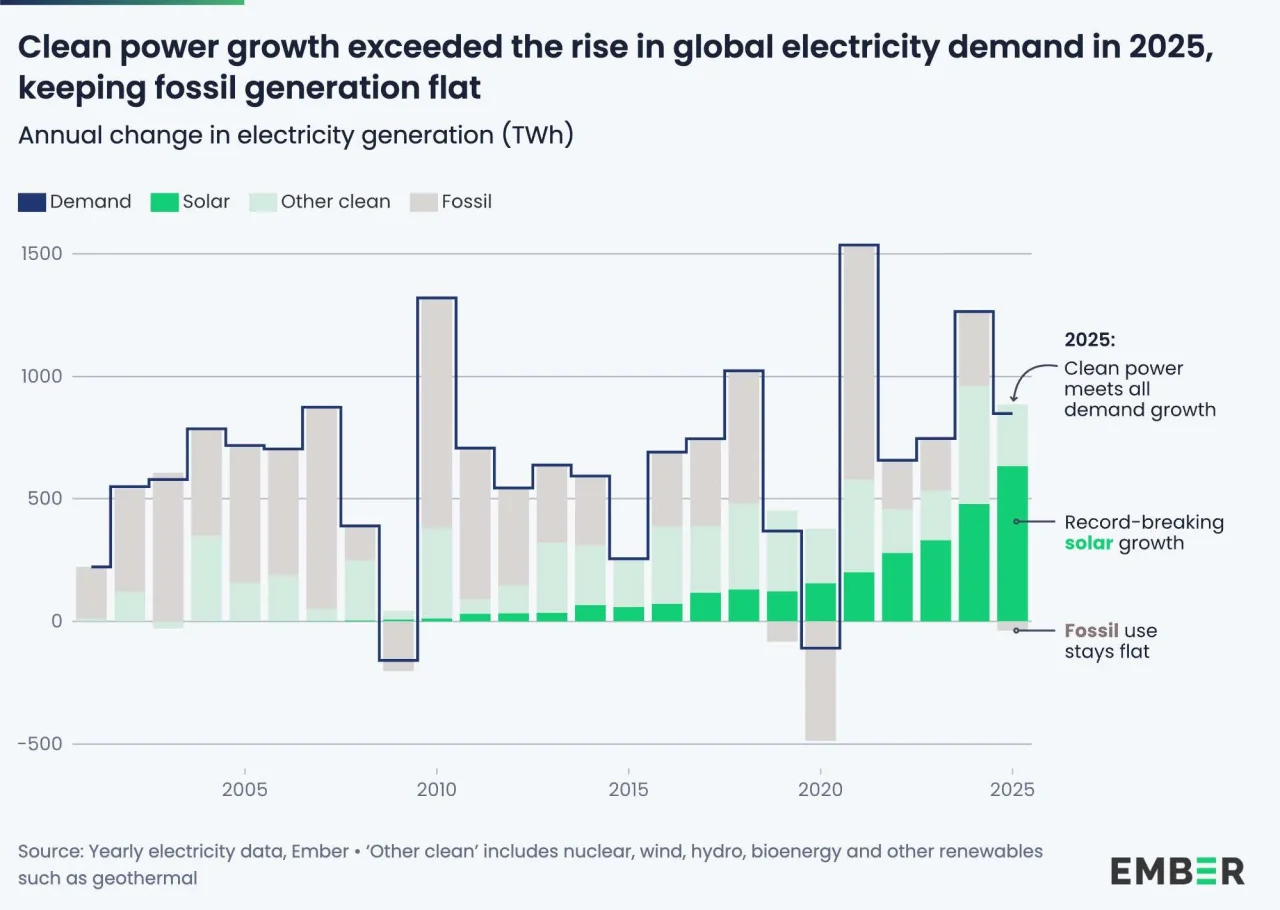
Nel 2025, global electricity generation entered a structural turning point. Clean energy sources fully covered the growth in global demand, effectively halting the expansion of fossil-based generation for the first time outside of economic crises. Following the International Energy Agency, the Global Electricity Review 2026 by Ember confirms that low-carbon generation increased by 887 TWh, exceeding the rise in global electricity demand, which stood at 849 TWh (+2.8%). This dynamic led to a slight decline in fossil generation of 38 TWh (-0.2%), an event recorded only five times this century. The result is largely driven by solar power, which alone accounted for 75% of demand growth, while combined with wind it covered 99% of the total increase. The global power system is now showing a clear decoupling between demand growth and fossil fuel use, marking a transition from a coal- and gas-based model to one increasingly dominated by scalable renewable technologies.
Solar boom reshapes global electricity generation
The most significant development in global electricity generation is the surge in solar. In 2025, photovoltaic generation increased by 636 TWh (+30%), reaching 2,778 TWh, the highest level ever recorded. This marks the largest annual increase ever observed for a single energy source, excluding the post-Covid coal rebound. Solar generation is now comparable to the entire electricity demand of the European Union and has surpassed wind for the first time, approaching nuclear. Growth continues on an exponential trajectory, with production increasing more than tenfold since 2015 and doubling approximately every three years. China remains the main driver, responsible for over half of global growth (+336 TWh), followed by the United States (+85 TWh) and the European Union (+60 TWh). This expansion is also supported by new capacity records, with 647 GW added in 2025 alone, signaling continued growth in the near term.
Renewables overtake coal in global electricity generation
For the first time in modern history, renewable electricity generation has surpassed coal. In 2025, renewables reached 33.8% of the global mix (10,730 TWh), compared to coal at 33.0% (10,476 TWh). This milestone is the result of combined solar and wind growth, which together now account for 17.3% of global generation, nearly four times their share in 2015. At the same time, coal’s share continues to decline, falling below one-third of the global mix for the first time. The reduction in coal generation (-63 TWh) and the decline in gas share contributed to improved emissions intensity, which dropped to 458 gCO2e/kWh (-2.7% year-on-year). This reflects an ongoing decarbonization process, although still uneven across regions.
China and India drive the decline in fossil generation
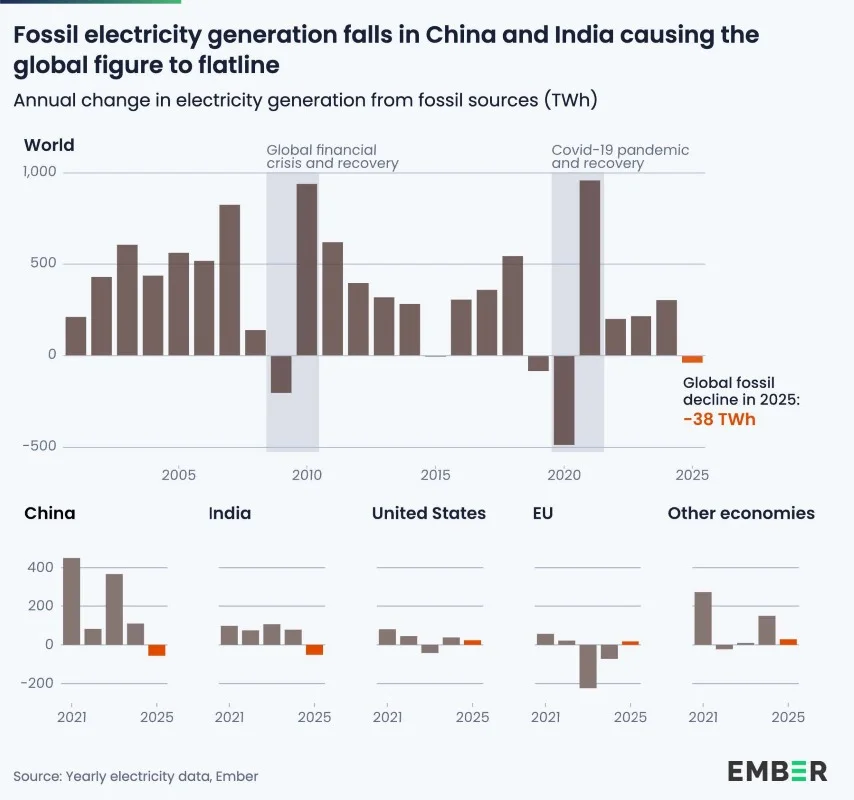
The slowdown in global fossil-based electricity generation is largely driven by China and India, which together account for 42% of global fossil generation. In 2025, both countries recorded a decline in fossil output: China by -56 TWh (-0.9%) and India by -52 TWh (-3.3%). This marks the first time this century that the two largest drivers of fossil growth have simultaneously reduced output. In China, electricity demand continues to rise (+503 TWh), but is entirely met by clean energy generation (+561 TWh), driven by solar and wind. In India, the decline is also supported by milder weather conditions and record renewable growth (+98 TWh). Overall, this resulted in a reduction of power sector emissions in the two countries of 79 MtCO2e, equivalent to the annual emissions of Brazil.
Storage enables continuous renewable electricity generation
A key factor in transforming electricity generation is the integration of solar with energy storage systems. In 2025, global battery capacity increased by 46% to approximately 250 GWh, while costs declined by 45%. This enables around 14% of new solar generation to be shifted from midday hours to other times of the day, reducing reliance on fossil fuels during evening peaks. In advanced markets such as Australia and Chile, batteries already shift more than 50% of new solar output, with direct impacts on electricity prices and reduced curtailment losses. The cost of solar generation combined with storage stands at approximately $76/MWh, making it competitive with new gas or coal plants. This marks the beginning of a new phase, transitioning from intermittent generation to continuous renewable energy availability.
Global electricity demand continues to rise
Global electricity generation demand reached a new record of 31,779 TWh in 2025, growing by 2.8%. The slowdown compared to 2024 is linked to temporary factors such as stable temperatures and reduced industrial activity, but the long-term trend remains upward. Key drivers include the electrification of transport and the expansion of data centers. Electric vehicles contributed 66 TWh (8%) to demand growth, while data centers added around 60 TWh (7%), with strong growth expected in the coming years. Despite this increase, clean energy generation continues to grow faster than demand, with an average annual growth rate of 7.6%, paving the way for stabilization and a potential decline in fossil generation within the next decade.


