The global surge in gas flaring highlights a worsening energy and climate challenge
Satellite data show that gas flaring 2025, the open burning of natural gas associated with oil production, not only persisted but increased for the third consecutive year. According to the latest Global Gas Flaring Tracker Report, published in June 2026 by the World Bank-led Global Flaring and Methane Reduction (GFMR) Partnership, global flaring volumes reached 167 billion cubic metres (bcm) in 2025, up 6% from 157 bcm in 2024. This marks the highest level recorded since 2019.
The 167 bcm of gas flared in 2025 exceeded the volume of LNG shipped through the Persian Gulf last year. The amount was large enough to match the annual natural gas consumption of the entire African continent, yet it was burned without generating any economic value.
Compared with 2012, the 2025 report recorded a 16% increase, equivalent to an additional 23 bcm of gas flared. Nearly half of that increase, around 10 bcm, occurred in 2025 alone. Flaring intensity, measured as the volume of associated gas burned per barrel of oil produced, also increased by almost 3% during the year.
The enormous waste of gas in 2025 was responsible for approximately 429 million tonnes of CO₂ equivalent emissions, including methane released through incomplete combustion. This represents an unacceptable paradox at a time when more than half a billion people across developing countries continue to face energy poverty.
The countries responsible for most global gas flaring
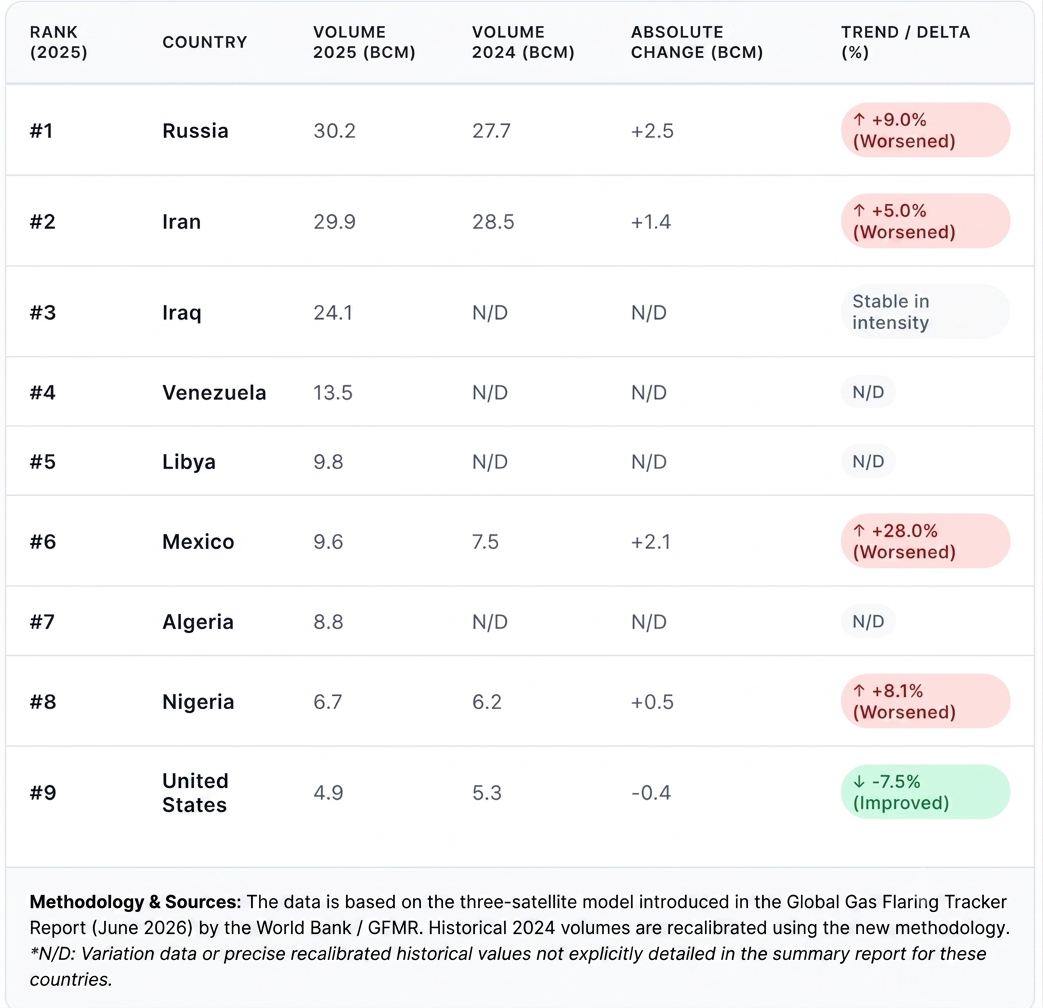
Global flaring remains heavily concentrated in a small number of producing countries. Just nine nations accounted for 83% of all gas flared worldwide, despite producing only 46% of global oil output. These countries, Russia, Iran, Iraq, Venezuela, Mexico, Libya, Algeria, Nigeria and the United States, were responsible for more than four-fifths of global flaring losses in 2025.
Russia regained the unwanted top position after Iran ranked first in 2024. In 2025, Russian flaring volumes increased by 9%, with the largest increases recorded in Eastern Siberia. This region alone accounted for 56% of the country’s total flaring.
Mexico also posted worrying results. Among major oil producers, it recorded the highest percentage increase in flaring volumes during 2025, rising by 28%. The deterioration has been linked to underinvestment, inadequate infrastructure and repeated maintenance operations at the Cantarell complex. As a result, Mexico moved from seventh place in 2024 to sixth place in 2025.
Gas flaring remains a major economic and energy security issue
The World Bank estimates that the market value of the gas unnecessarily flared in 2025 reached USD 54 billion. Meanwhile, the International Energy Agency estimates that eliminating routine flaring worldwide would require around USD 70 billion in upfront investment, rising to almost USD 100 billion if full methane abatement is included.
This means that the value of the gas wasted in a single year already represents nearly three-quarters of the total infrastructure investment needed to solve the problem permanently.
Stronger policies are essential to eliminate routine flaring
The persistence of gas flaring is not the result of technological limitations. Instead, it reflects structural barriers, weak economic incentives and insufficient political commitment.
The report highlights rising flaring trends in Vietnam, the United Arab Emirates and Malaysia. By contrast, Kazakhstan has continued its strong progress, reducing flaring by 87% since 2012. The United States also recorded the largest absolute reduction in flaring volumes during 2025. These examples demonstrate that effective solutions already exist and can be implemented when supported by robust policy frameworks.
With only four years remaining to achieve the global Zero Routine Flaring by 2030 (ZRF) target, the gap between current trends and the complete elimination of routine gas flaring continues to widen. Greater coordination between governments, financial institutions and oil companies has therefore become increasingly urgent.