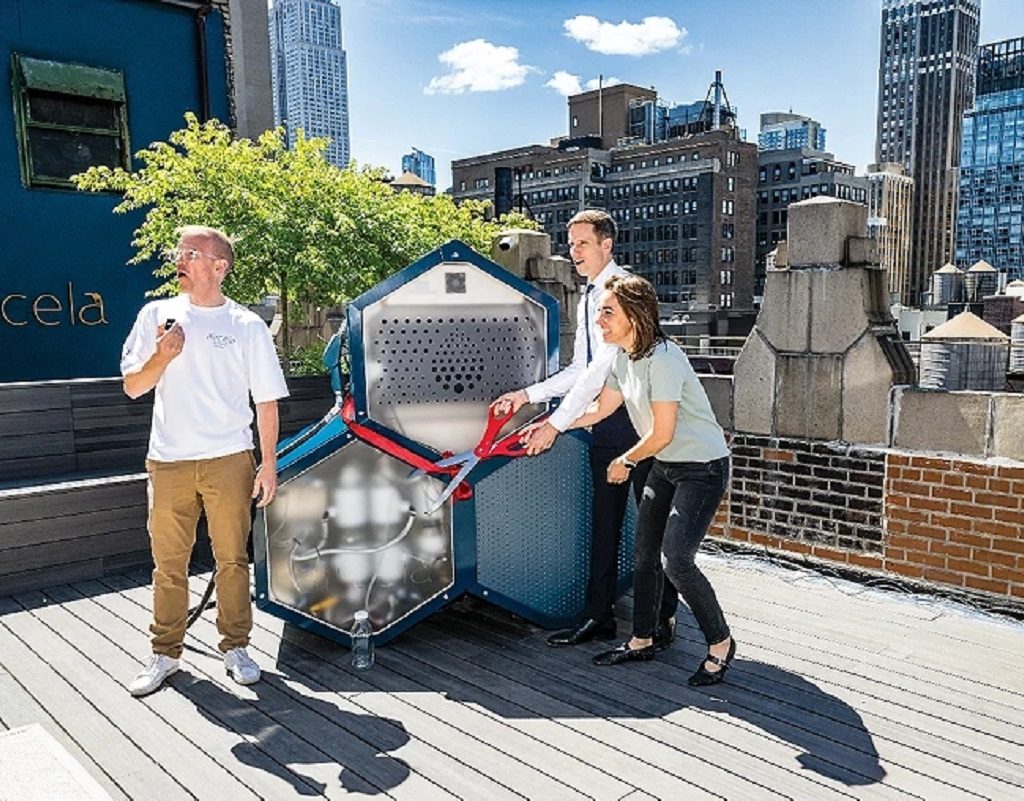
Turning carbon dioxide, water and renewable electricity into synthetic gasoline may sound like a dream, particularly in today’s energy landscape. Yet a US startup has developed a machine capable of producing up to 3.8 litres of e-fuel per day, suitable for use in conventional petrol-powered vehicles.
The technology sounds almost like science fiction. Developed by Aircela, a New York-based company, the device captures CO2 directly from the atmosphere, extracts hydrogen from water and combines the two using renewable electricity to produce synthetic fuel.
Three steps to produce synthetic gasoline from air
It may seem too good to be true, but the technology is already a reality. Engineers at Aircela have developed a compact device, roughly the size of a household refrigerator, that integrates three separate chemical processes into a modular system comprising three interconnected hexagonal units.
The first stage involves capturing atmospheric CO2 through a potassium hydroxide-based liquid solution, a process known as Direct Air Capture (DAC).
The second stage uses an electrolyser powered by renewable electricity to split water molecules, producing hydrogen while releasing oxygen into the atmosphere.
The third and final stage involves combining carbon dioxide and hydrogen to synthesise methanol, which is subsequently converted into synthetic gasoline free from sulphur, ethanol and heavy metals.
One of the technology’s most significant advantages is that the resulting e-fuel can be used directly in conventional internal combustion engines without requiring any modifications.

Limited production capacity remains a major challenge
At present, Aircela’s technology can produce approximately one gallon of synthetic gasoline per day, equivalent to just under four litres.
The device can capture 10 kg of CO2 daily and requires 75 kWh of electricity to complete the fuel production process.
Although this type of synthetic fuel has a lower environmental impact than conventional petroleum-derived gasoline, it is not a zero-emission fuel.
When burned in an internal combustion engine, it still generates thermal nitrogen oxides (NOx) and releases CO2 through the exhaust system.
Nevertheless, there are important differences between synthetic gasoline from air and conventional fossil fuels, particularly regarding the origin of the carbon used in production.
Synthetic gasoline from air vs conventional petrol
The fundamental difference lies in the source of the carbon. Synthetic gasoline uses CO2 captured from the atmosphere rather than carbon extracted from petroleum reserves.

When the production process is powered by renewable electricity, the resulting fuel can have a relatively low emissions footprint.
However, the real challenge is producing synthetic gasoline at industrial scale and at competitive costs. Without achieving both objectives, the technology risks remaining little more than a laboratory demonstration.
Aircela believes its approach could support a decentralised fuel production model, particularly in remote locations or sectors where electrification is more difficult.
“By designing compact, modular machines, we can produce fuel directly where it is needed, reducing transportation costs, simplifying logistics and enabling production even in remote or hard-to-supply locations,” explains Liz White of Aircela.
The technology could therefore provide another means of reducing the environmental impact of mobility and transport, offering an alternative to fossil-based fuels.
In fact, the most promising applications for e-fuels are not necessarily urban passenger cars, but heavy-duty transport, shipping and, above all, aviation.
Can decentralised production make synthetic gasoline competitive?
Scaling up the process remains a complex challenge. However, rather than relying on large, centralised production facilities, Aircela aims to manufacture numerous smaller units.
The startup believes this modular approach could reduce production costs much faster than a conventional centralised plant, potentially making synthetic gasoline from air a more practical alternative to petroleum-derived fuels.
The commercial viability of the technology will ultimately depend on whether this decentralised model can deliver sufficient production volumes at competitive prices.