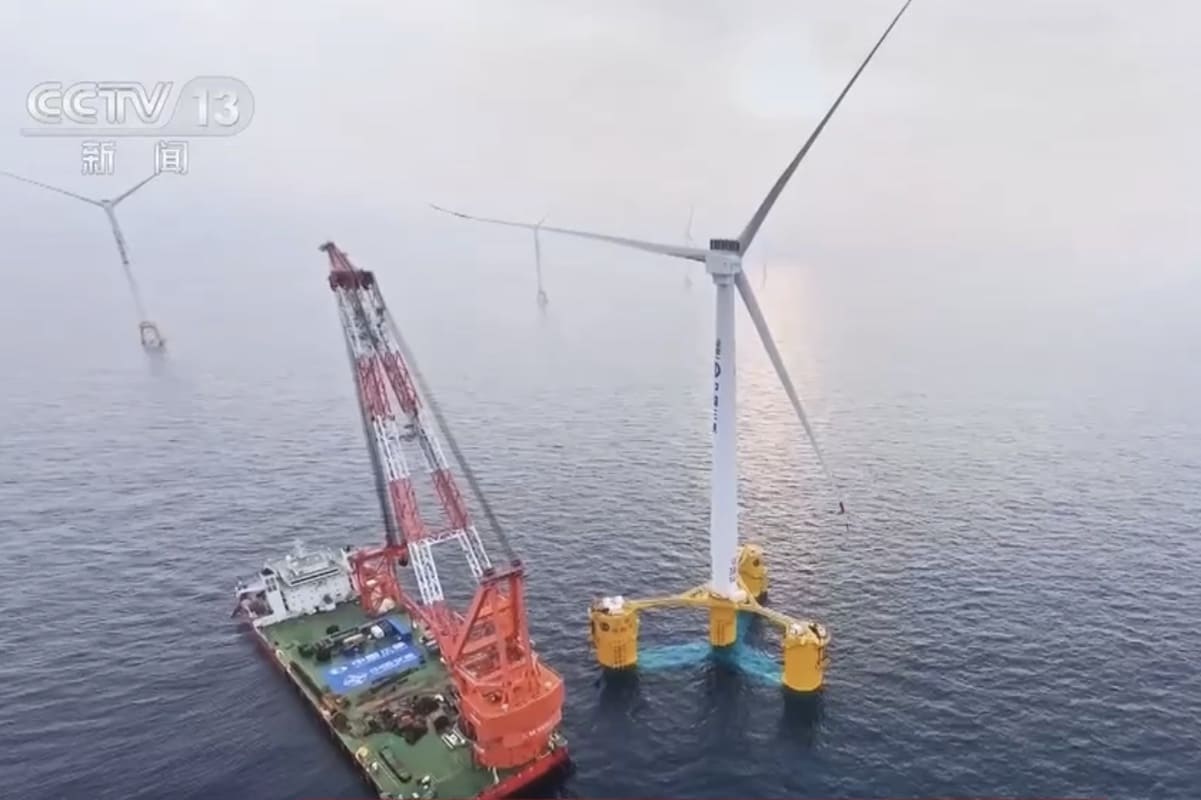
Sanxia Linghang sets a new benchmark for floating wind turbine technology
How do you secure, and maintain, the top position in the global wind turbine manufacturing industry? One answer may be to deploy the world’s first 16 MW floating wind turbine.
That is precisely the latest achievement of Chinese manufacturer Goldwind, ranked first in the Global Wind Turbine OEMs 2025 report by Wood Mackenzie. Together with the China Three Gorges Corporation (CTG), the company officially inaugurated the Sanxia Linghang platform on May 2, 2026, the offshore floating wind installation with the world’s highest single-unit capacity.
At 16 MW, the project marks another milestone in the global energy transition race.
Extreme offshore conditions challenge the 16 MW floating wind turbine
Installed capacity alone is not the only remarkable feature of the Sanxia Linghang project.
The operational site of the floating wind turbine is located more than 70 km off the coast of Yangjiang, in China’s Guangdong province on the South China Sea. Water depths in the area exceed 50 meters, while the region is regularly exposed to category-17 typhoons and waves surpassing 20 meters in height.
These conditions represent a major engineering challenge for conventional offshore wind systems, and even more so for a 16 MW turbine equipped with a 252-meter rotor diameter and a total height exceeding 270 meters, including blades.
Advanced mooring systems improve floating wind turbine stability
To guarantee stability under such extreme marine conditions, Goldwind’s engineers integrated two key technological innovations into the platform design:
- A next-generation composite cable mooring system
- An active ballast control system capable of maintaining stable floating conditions
The mooring solution combines high-strength steel chains with specialized polyester fiber ropes. These elastic ultra-resistant cables absorb wave motion energy and reduce peak structural loads.
Each individual cable can withstand approximately 1,300 tons of tension, equivalent to the weight of around 20 Airbus A320 aircraft.
To further optimize the design, engineers reduced the mooring radius by more than 200 meters compared with the first-generation system. The adjustment helps save maritime space while supporting the future deployment of large-scale offshore wind farms.
Active ballast technology supports offshore wind platform resilience
The active ballast system was developed by the CTG engineering team in collaboration with the China Ship Scientific Research Center.
Using high-precision sensors, the technology automatically regulates water volumes inside the three lateral columns of the floating platform, allowing the structure to correct a 3-degree tilt in just 30 minutes.
“One of the sector’s main challenges was the lack of coordination between the wind turbine and the floating platform,” China Three Gorges explained on its official website.
“Under the combined action of wind, waves and currents, the support structure and the wind turbine are subject to dynamic coupling. In the past, components were often designed separately, leading to data discrepancies during iterative development. To solve the issue, engineers adopted an integrated design philosophy, validating real environmental parameters over a year and a half until the coordinated design challenges were overcome.”
China strengthens its leadership in floating wind turbine innovation
With the launch of the Sanxia Linghang platform, China secures yet another technological leadership position in the global energy transition.
The project highlights how floating wind turbine technologies are rapidly evolving beyond pilot-scale applications toward utility-scale deployment capable of operating in deep-water and extreme-weather environments.