Electricity and renewables reshape global energy demand
In 2025, global energy demand increased by 1.3%, but the structure of the system is shifting. Electricity and low-emission technologies are driving growth, even as emissions reach new highs.
The International Energy Agency Global Energy Review 2026 highlights a sector in transition, with slower consumption growth, accelerating electrification, expanding clean technologies, and a continued central role for fossil fuels.
Total demand reached 655 exajoules, while electricity demand grew by around 800 TWh, or 3%, more than double the pace of total energy demand. Low-emission sources covered nearly 60% of the increase, yet emissions climbed to 38.4 billion tonnes of CO2.
This represents an absolute increase of about 8 exajoules compared to 2024. At the same time, global GDP grew by 3.1%, slightly below 2024 levels, while energy intensity improved by around 2%, above the 1.3% average recorded between 2019 and 2024.
Solar becomes the leading driver of global energy demand
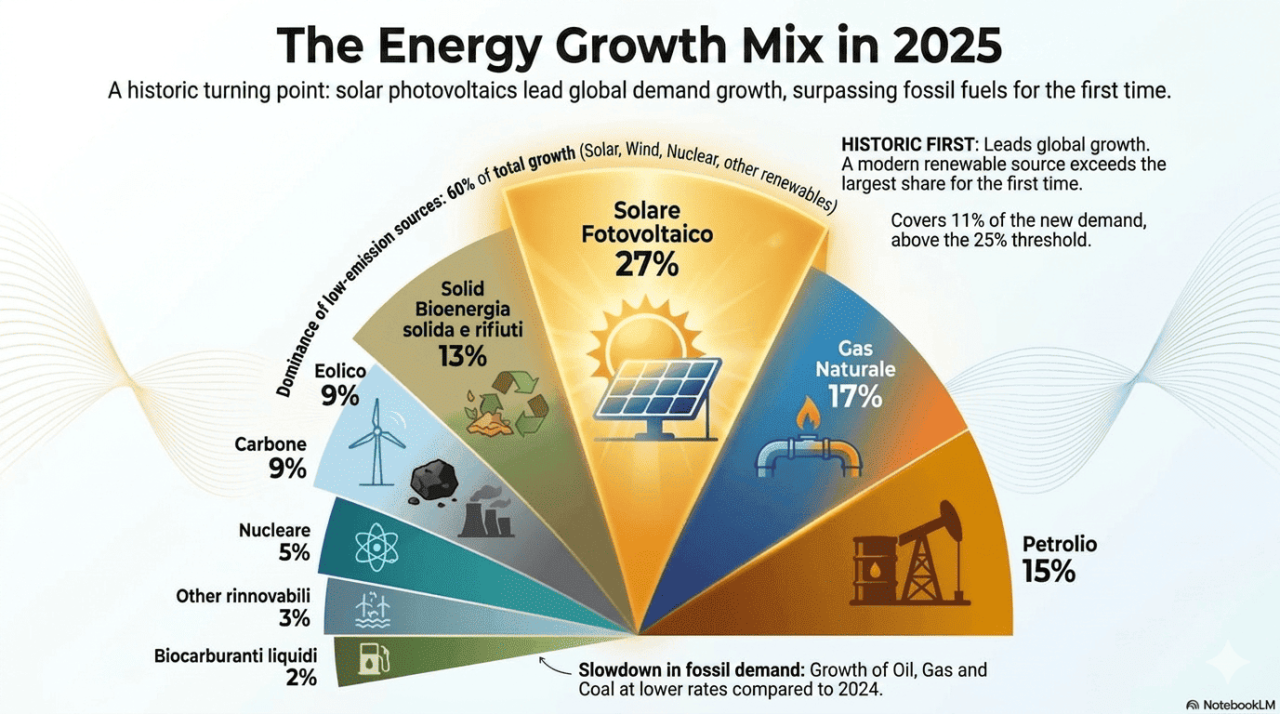
In 2025, renewables reached a historic milestone in meeting global energy demand growth. Solar photovoltaics alone accounted for more than 27% of the increase, becoming the largest contributor for the first time.
Natural gas followed with 17%, oil with around 15%, while solid bioenergy and waste contributed 13%. Wind and coal each accounted for roughly 9%. Other renewables, including hydropower and geothermal, contributed around 3%, while liquid biofuels added about 2%.
This confirms a structural shift: renewables are now the main engine of energy expansion. Overall, low-emission sources accounted for nearly 60% of total growth. However, demand continues to rise across all sources, showing that the transition is not yet reducing fossil fuel use in absolute terms.
Electricity demand grows at twice the pace
Global energy demand is increasingly tied to electricity consumption. In 2025, electricity demand grew by about 3%, more than double the rate of total energy demand, confirming the shift toward an “age of electricity”.
Buildings accounted for around 45% of this increase, followed by industry and services. New applications are also playing a growing role: data centers saw demand rise by 17%, while electric vehicles grew by 38%. In the United States, data centers alone accounted for 50% of electricity demand growth.
In absolute terms, data centers contributed about 70 TWh, while transport accounted for more than 10% of total growth, compared to an average of 4% between 2014 and 2024.
This highlights a deeper transformation, with more sectors shifting toward electricity, making power systems the core of the energy transition, a dynamic increasingly relevant in fast-growing African economies such as South Africa and Kenya, where electrification is expanding.
Regional dynamics shift global energy demand
Global energy demand growth in 2025 shows strong regional differences. China remains the largest contributor, but growth slowed to 1.7%, reflecting gains in efficiency and renewables.
The United States saw demand accelerate beyond 2%, driven by industrial activity, cold weather, and data center consumption. The European Union recorded a slight decline of 0.1%, while India slowed to around 1%.
In contrast, Africa and the Middle East experienced stronger growth, pointing to a geographic redistribution of demand, with emerging regions playing a more prominent role.
Weather impacts global energy demand
In 2025, climate factors had a direct impact on global energy demand. A colder winter in advanced economies increased natural gas consumption, adding more than 16 billion cubic meters to global demand.
Conversely, an early monsoon in India reduced electricity demand and coal use, while drought conditions in Europe and Latin America limited hydropower output, increasing reliance on fossil fuels.
Overall, weather-related effects contributed about 90 million tonnes of additional CO2 emissions, highlighting the growing vulnerability of energy systems to climate variability.
Temperature variations also played a role, with global cooling degree days 6% lower than in 2024. Weather fluctuations contributed about 16 bcm of the 40 bcm increase in global gas demand. Reduced hydropower output added roughly 40 million tonnes of CO2, while total weather impacts accounted for about 90 million tonnes of the overall emissions increase.
Record growth for renewables in 2025
The year 2025 marked unprecedented expansion for clean technologies. Electric vehicle sales exceeded 21 million units, representing one in four cars sold globally.
Energy storage also surged, with 108 GW of new capacity installed, up 40% from 2024, bringing total capacity to more than eleven times 2021 levels.
Renewables reached a new record with 800 GW of new installations, around 75% of which came from solar. Total photovoltaic capacity reached approximately 2,800 GW.
Renewables cover all electricity growth
Global electricity generation increased by more than 850 TWh in 2025, with the entire growth covered by low-emission sources.
Solar recorded a record increase of 600 TWh, while wind grew by 8%.
Coal remained the largest source, accounting for 34% of generation, but declined slightly. Natural gas grew only marginally. The overall share of low-emission sources reached 43%, the highest level in fifty years.
Total electricity generation rose from 31,260 TWh in 2024 to 32,132 TWh in 2025. Renewables increased from 9,947 to 10,808 TWh (+8.7%), while coal fell slightly from 10,907 to 10,858 TWh (-0.4%). Gas generation rose marginally, while oil declined.
Fossil fuels remain essential
Despite the growth of renewables, fossil fuels continue to play a key role. Oil demand increased by 0.7%, confirming a structural slowdown, largely due to electrification and efficiency improvements.
Natural gas demand grew by 1%, strengthening its role as a flexible energy source. Coal rose by just 0.4%, signaling global stagnation.
The data shows a system in transition, but still heavily reliant on fossil fuels.
Global emissions reach a new record
Energy-related emissions rose by 0.4% in 2025, reaching a record 38.4 billion tonnes of CO2.
Growth was slower than in previous years and below global GDP growth, indicating a gradual decoupling between economic activity and emissions. Natural gas was the main driver of emissions growth, while coal remained stable.
Clean technologies deployed since 2019 avoided about 35 exajoules of fossil energy demand in 2025, equal to 7% of the global total.
They also prevented around 3 billion tonnes of CO2 emissions, or about 8% of global emissions. Solar accounted for the largest share, avoiding 1.5 billion tonnes, followed by wind at 1.1 billion tonnes.
Low-emission sources reached 43% of global electricity generation, while renewables alone accounted for 34%, up from 32% in 2024 and 23% a decade ago. Solar and wind combined reached 17%, compared to just 5% ten years ago.