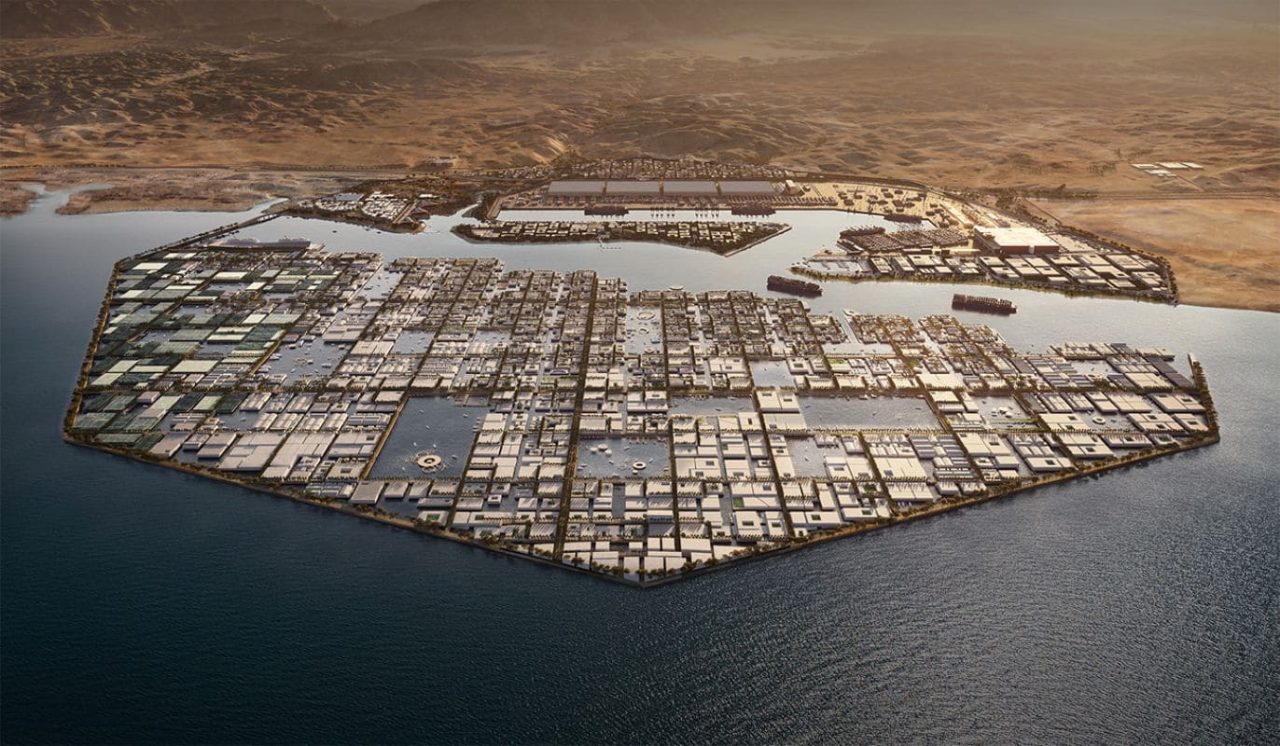
Green hydrogen production at NEOM under pressure from weak demand
The future of green hydrogen production at NEOM’s Oxagon site appears increasingly uncertain. Despite announcements that construction has reached 80% completion, concerns are emerging over the absence of firm buyers for the fuel.
The $8.4 billion project is being developed by NEOM Green Hydrogen Company (NGHC), a joint venture between ACWA Power, Air Products and NEOM. However, sources close to the initiative told Bloomberg that the site may face operational challenges due to limited confirmed offtake agreements.
According to the report, the project is considering a potential scale-down or phased approach in response to weaker-than-expected global demand. Two anonymous sources described the situation as a “deep and silent crisis.”
Limited buyers for green hydrogen production
Originally designed as a fully export-oriented facility, the plant was expected to sell its entire output abroad. Yet only around one-third of planned green hydrogen production has secured a buyer so far.
The only confirmed agreement is with TotalEnergies for 70,000 tonnes annually between 2030 and 2045. No additional contracts have been announced.
The Oxagon facility was conceived as a cornerstone of Saudi Arabia’s Vision 2030 strategy, aimed at transforming the Kingdom’s economy under Crown Prince Mohammed bin Salman. However, the shortage of confirmed customers is prompting project backers to reconsider development timelines, potentially shifting to a modular expansion model based on secured supply contracts.
The plant, powered by 4 GW of renewable energy feeding electrolyzers, was originally expected to produce 600 tonnes per day of green hydrogen by 2027.
Rising costs and regulatory uncertainty
Project costs have risen significantly, from an initial estimate of $5 billion to the current $8.4 billion, finalized at financial close two years ago.
Air Products, the main industrial partner, stated that construction continues according to schedule, but confirmed a delay in planned investments in Europe.
“In the near term, we are focused on building and selling green ammonia from Saudi Arabia while hydrogen regulations stabilize,” the company said.
Bloomberg notes that NEOM’s challenges reflect broader structural issues facing the global green hydrogen sector, particularly high production costs and limited commercial uptake of hydrogen-derived products such as synthetic fuels.
Despite current headwinds, green hydrogen production remains central to Saudi Arabia’s long-term energy strategy, as the Kingdom seeks to retain its position as a global energy supplier in a post-transition landscape.