Perovskite-CIGS solar cells move closer to commercial scale
After the breakthroughs achieved with perovskite-silicon and all-perovskite tandem devices, another major milestone has been reached in the field of multi-junction photovoltaics. Researchers at the University of Tokyo have developed a perovskite-CIGS tandem solar cell, based on copper indium gallium diselenide technology, capable of achieving a power conversion efficiency of 25.14%.
While this is not the highest efficiency ever recorded for this material combination, the result establishes a new world record in terms of cell size. That distinction makes the achievement particularly significant for the future industrialization of tandem solar technologies.
Multi-junction solar cells and the scale-up challenge
Combining two or more junctions within a single solar cell is widely considered one of the most promising strategies to push photovoltaic performance beyond the Shockley-Queisser limit, increasing electricity generation while reducing module size.
Today, tandem architectures are included in the technology roadmaps of many solar manufacturers. However, large-scale commercialization remains challenging. One of the biggest obstacles is scale-up, namely reproducing laboratory-level performance on commercially relevant cell dimensions.
Current research clearly highlights this technological gap. The world efficiency record for perovskite-CIGS photovoltaics is currently held by researchers from Seoul National University and the Korea Institute of Science and Technology (KIST), who in May 2025 presented a tandem solar cell capable of converting 26.3% of sunlight into electricity. However, that device had a photoactive area of only 0.222 cm². By comparison, commercial photovoltaic cells today typically range between 331 cm² and 441 cm².
This is precisely why the University of Tokyo’s perovskite-CIGS solar cell represents a new global benchmark. Although the researchers achieved a slightly lower efficiency of 25.14%, they did so on a 1 cm² device, improving scalability by 350%.
The University of Tokyo’s approach to tandem photovoltaics
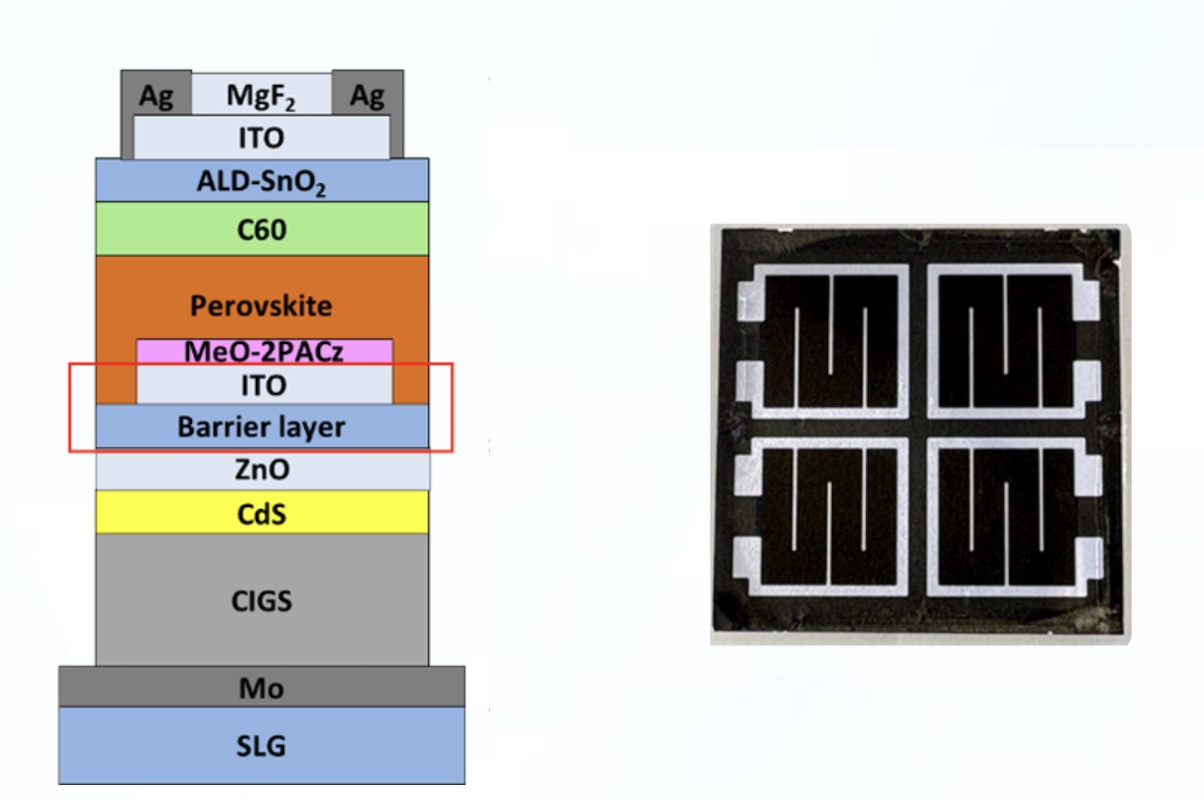
Achieving this result required a multi-layered engineering strategy. The research team focused on the charge carrier recombination layer, a critical component that electrically connects the upper and lower cells in tandem architectures.
This layer sits at the center of the photovoltaic “sandwich.” However, chemical incompatibilities at the interface can generate structural defects in the crystal lattice, causing charge losses that reduce overall efficiency.
By introducing a barrier layer on the lower CIGS cell, the Japanese researchers improved the crystallinity of the perovskite layer formed on its surface. This significantly enhanced the performance of the upper cell.
“Further efficiency improvements can be achieved by optimizing the composition of both the perovskite and CIGS layers to improve short-circuit current,” the scientists explained.
“In addition, we will accelerate research and development toward practical applications by improving durability through advances in additives and passivation technologies, advancing tandem technology using flexible CIGS bottom cells, and developing large-area fabrication processes for perovskite solar cells.”
Future applications for perovskite-CIGS photovoltaics
Despite these advances, perovskite-silicon tandem photovoltaics still operate at substantially higher efficiency levels than perovskite-CIGS devices. Nevertheless, researchers continue to invest in this alternative pathway for a strategic reason.
Both perovskites and copper indium gallium diselenide can be manufactured as thin films, opening the door to lightweight, flexible, and adaptable solar technologies suited to challenging environments.
According to the university’s press release, these solar cells could eventually be installed on factory and warehouse rooftops with structural load limitations, curved roofs, and building facades, creating new renewable energy opportunities, especially in densely populated urban areas where land availability is constrained.
The technology could also unlock new markets, including applications for electric vehicles and drones.