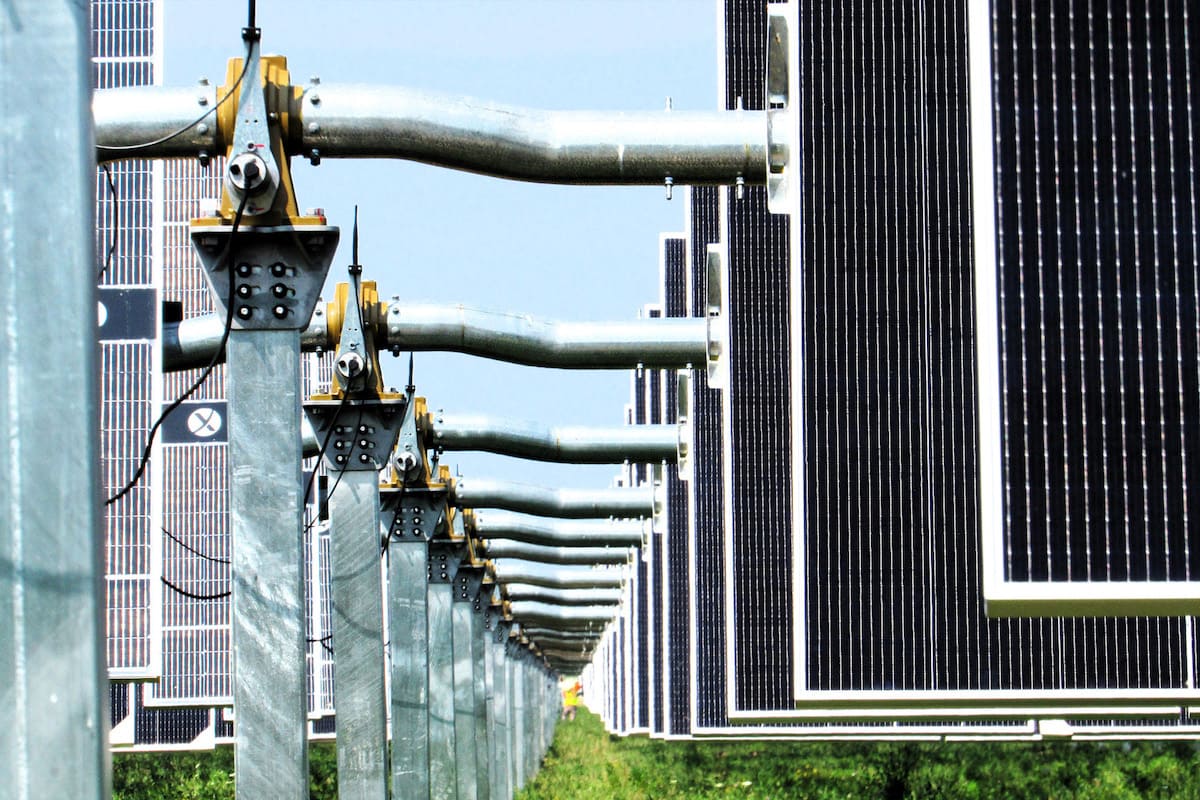
Solar trackers market sets new global record in 2024
The global solar trackers market delivered a record performance in 2024, shipping systems equivalent to 111 GW of photovoltaic capacity. That represents a 20% increase over 2023, which itself had already grown by 28% compared to the previous year.
The findings come from the report Global solar PV tracker market share 2024, published by Wood Mackenzie. The analysis provides a comprehensive overview of manufacturer rankings and regional demand, with market shares calculated based on trackers shipped and measured against the direct current capacity of the PV projects they serve.
Market leadership consolidates among major players
A review of 2024 results shows that the competitive landscape among leading suppliers remains largely consistent with 2023. Major players consolidated their positions, with limited reshuffling at the top.
For the tenth consecutive year, US-based Nextracker led the solar trackers sector, capturing a 26% global market share. The company expanded its lead through 39% annual growth, supported by geographically diversified demand and the opening of a new factory in Nevada. Since 2021, Nextracker has opened or expanded more than 20 manufacturing facilities in the United States.
International demand, particularly from India, played a decisive role. Nextracker’s Indian project portfolio now exceeds 10 GW.
China’s Arctech Solar secured second place with roughly 16% market share, overtaking US competitors Array Technologies, GameChange Solar and PV Hardware.
This advancement followed an aggressive international expansion strategy, including new production bases in Saudi Arabia and Brazil, the establishment of an R&D center in the Middle East and the relocation of its European headquarters to Madrid. The strategy strengthened Arctech’s presence in both Saudi and Indian markets.
India and Saudi Arabia reshape the solar trackers market
India and Saudi Arabia together accounted for 28 GW of tracker demand in 2024, surpassing total European demand for the year.
“The year was marked by the rapid growth of the Indian and Saudi tracker markets, reshaping the US-dominated podium that had prevailed since 2023,” said Joe Shangraw, Associate Research Analyst at Wood Mackenzie.
Arctech’s case is not unique. Other Chinese suppliers also expanded overseas in 2024 as domestic demand slowed.
The US market for solar trackers recorded a 9% decline, marking its first contraction in eight years. Meanwhile, Europe remained one of the most competitive and diversified markets, with more than nine suppliers each holding between 5% and 15% market share.
Spain posted its highest-ever demand in 2024, driven by Solar Steel and Nextracker. However, much of Europe’s growth came from emerging Southern and Central European markets, where companies such as Axial Structural Solutions, Zimmermann and TrinaTracker gained new traction.
Technological innovation in solar tracking systems
Technological advances also shaped the sector in 2024. The German research project DeepTrack, led by Fraunhofer ISE and Zimmermann PV-Tracker, aims to significantly enhance the efficiency of solar trackers, particularly for bifacial modules and agrivoltaic applications.
The initiative leverages artificial intelligence-based control algorithms to optimize tracker positioning. Single-axis and dual-axis systems already deliver 20–30% higher output compared to fixed-tilt installations. DeepTrack seeks to refine orientation criteria by incorporating diffuse light utilization and adapting to agrivoltaic needs, such as light modulation for underlying crops.
The project employs a digital twin combining real-time data, photovoltaic modeling and weather forecasts with deep learning to identify optimal module positions. The objective is to balance maximum energy yield with agricultural requirements.
Improving performance and reliability
A recent study from the IEA PVPS Task 13 working group, involving Italian researcher Giosuè Maugeri from RSE, outlines guidelines to further optimize solar trackers. Based on literature review, industry standards and interviews with 16 leading companies operating more than 13 GW of installations, the report identifies several key improvement areas:
- Greater transparency and on-site comparative testing of tracking algorithms
- Additional research into low-cost albedo enhancement materials
- Standardization of tracker response to extreme weather events
- Improved capacity testing methodologies, especially in high DC/AC ratio systems
- More validated data to reduce variability in photovoltaic performance models
- Enhanced research on long-term reliability of single-axis systems
The findings underscore the importance of continuous innovation as global solar deployment accelerates.