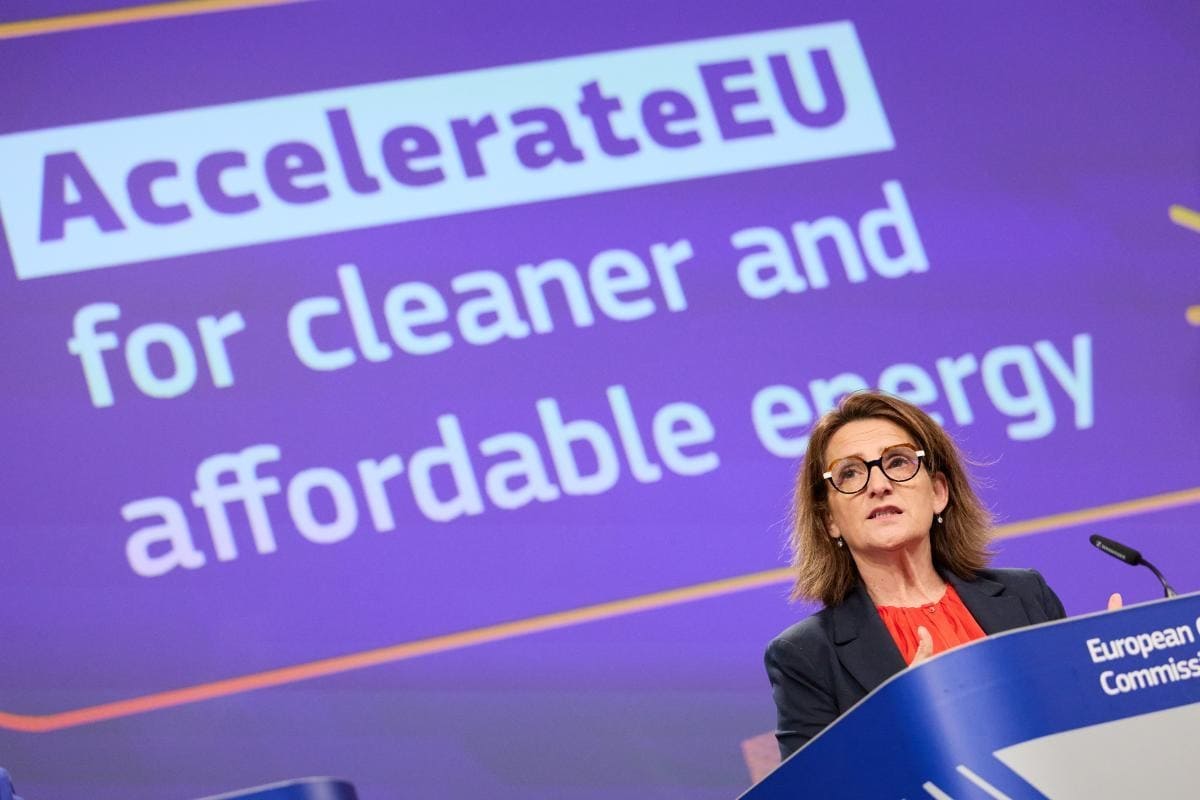
AccelerateEU, the EU plan to tackle the 2026 energy crisis
The European Commission has unveiled the AccelerateEU plan, its strategic response to the 2026 energy crisis, combining emergency measures with structural reforms aimed at accelerating the shift to renewables and strengthening energy independence. Presenting the package on April 22, 2026, Commission President Ursula von der Leyen stressed that today’s decisions will shape Europe’s ability to face both current and future crises.
The initiative comes amid renewed geopolitical instability linked to tensions in the Middle East, which have disrupted global energy flows. The plan aims to provide immediate relief to households and businesses while laying the groundwork for a more resilient and secure energy system.
AccelerateEU plan: immediate response and long-term energy security
AccelerateEU is centered on immediate support for citizens and industries affected by energy price shocks. The Commission proposes a series of measures, including income support schemes, energy subsidies, and tax reductions on electricity. Member States are encouraged to offer fiscal incentives for solar photovoltaic systems, heat pumps, and small-scale storage solutions, as well as reduce VAT for electric vehicles. Additionally, the plan focuses on simplifying access to energy communities and supporting self-generation of energy.
AccelerateEU plan and the role of the European Green Deal
Brussels has made clear that the AccelerateEU plan will not deviate from the path set by the European Green Deal. On the contrary, the current crisis reinforces the need to accelerate the energy transition. According to Teresa Ribera, Executive Vice-President for a Clean, Just and Competitive Transition, there are no viable alternatives to the Green Deal, as Europe continues to pay the price of its dependence on fossil fuels.
Since the beginning of the Middle East conflict, the European Union has spent an additional €24 billion on energy imports, largely fossil fuels, despite stable volumes. Even if hostilities were to cease immediately, supply disruptions from the Persian Gulf are expected to persist, requiring a longer-term strategic approach.
Consumer protection measures under the AccelerateEU plan
The AccelerateEU plan includes a wide range of measures designed to shield both households and industries from energy price shocks. These include income support schemes, energy subsidies, social tariffs, and tax reductions on electricity. Member States are also encouraged to reduce VAT on heat pumps, solar photovoltaic systems, and small-scale storage solutions, while offering fiscal incentives for electric vehicles. The plan emphasizes the need to simplify access to energy communities, support self-generation, and enable consumers to easily compare and switch energy suppliers.
Energy taxation reform and industrial support
The European Commission is preparing a legislative proposal to revise network charges and energy taxation, with the goal of lowering electricity bills and promoting efficient consumption.
At the same time, it plans to mobilize €100 billion through the Industrial Decarbonisation Bank to support industry. This includes incentives for energy-intensive sectors funded through 400 million EU ETS allowances. A digital platform will also be created to share non-confidential information on national emergency measures, improving coordination across Member States.
State aid flexibility and grid development
A new temporary framework for state aid is under development, aimed at giving governments greater flexibility to support the most exposed sectors. However, electrification must be matched by adequate grid infrastructure. The Commission highlights the importance of fully implementing existing legislation and rapidly concluding negotiations on the European grid package.
Electrification strategy at the core of the AccelerateEU plan
By summer 2026, the EU will launch a dedicated electrification action plan, setting ambitious targets and removing barriers to the adoption of electricity across industry, transport, and buildings.
Maximizing existing renewable infrastructure is a key priority. Rapid upgrades of large wind farms, offshore installations, and hydropower plants are expected to deliver additional capacity in the short term, helping stabilize the energy system.
Transport measures and fuel security
In the transport sector, the AccelerateEU plan focuses on ensuring fuel availability and mitigating price volatility. The Commission plans to establish a Fuel Observatory by May 2026 to monitor supply, stock levels, including military reserves, and refining capacity across Europe.
It also aims to coordinate emergency fuel reserves, particularly jet fuel and diesel, ahead of peak summer demand. Additional measures include support for aviation through regulatory flexibility and a revision of the oil stocks directive.
At the same time, structural solutions are being promoted to reduce oil dependency. These include incentives for electric vehicles, expansion of charging infrastructure, port electrification, and new social leasing models. For hard-to-electrify sectors, the EU is accelerating the deployment of sustainable aviation fuels and maritime fuels.
Gas storage coordination to stabilize markets
The AccelerateEU plan also introduces stronger coordination on gas storage. From April 2026, the Commission will guide the timing of gas purchases by market operators to avoid price spikes caused by simultaneous procurement.
Member States are encouraged to use existing flexibility rules, allowing storage targets to deviate by up to 10%. The Commission is also considering increasing this threshold by an additional 5% under the updated EU gas storage regulation.