


Global coal mine methane emissions have not declined since 2021, with most releases still missing from official inventories, highlighting a major gap in climate action.

Coal mine methane emissions show no decline since 2021
Global coal mine methane emissions have remained largely unchanged since 2021, according to a new report by Ember.
The first edition of the Global Coal Mine Methane Review provides the most comprehensive analysis to date of methane emissions from coal mining. The study is based on data from 73 coal-producing countries, alongside independent estimates and satellite observations.
Global methane pledge has yet to deliver results
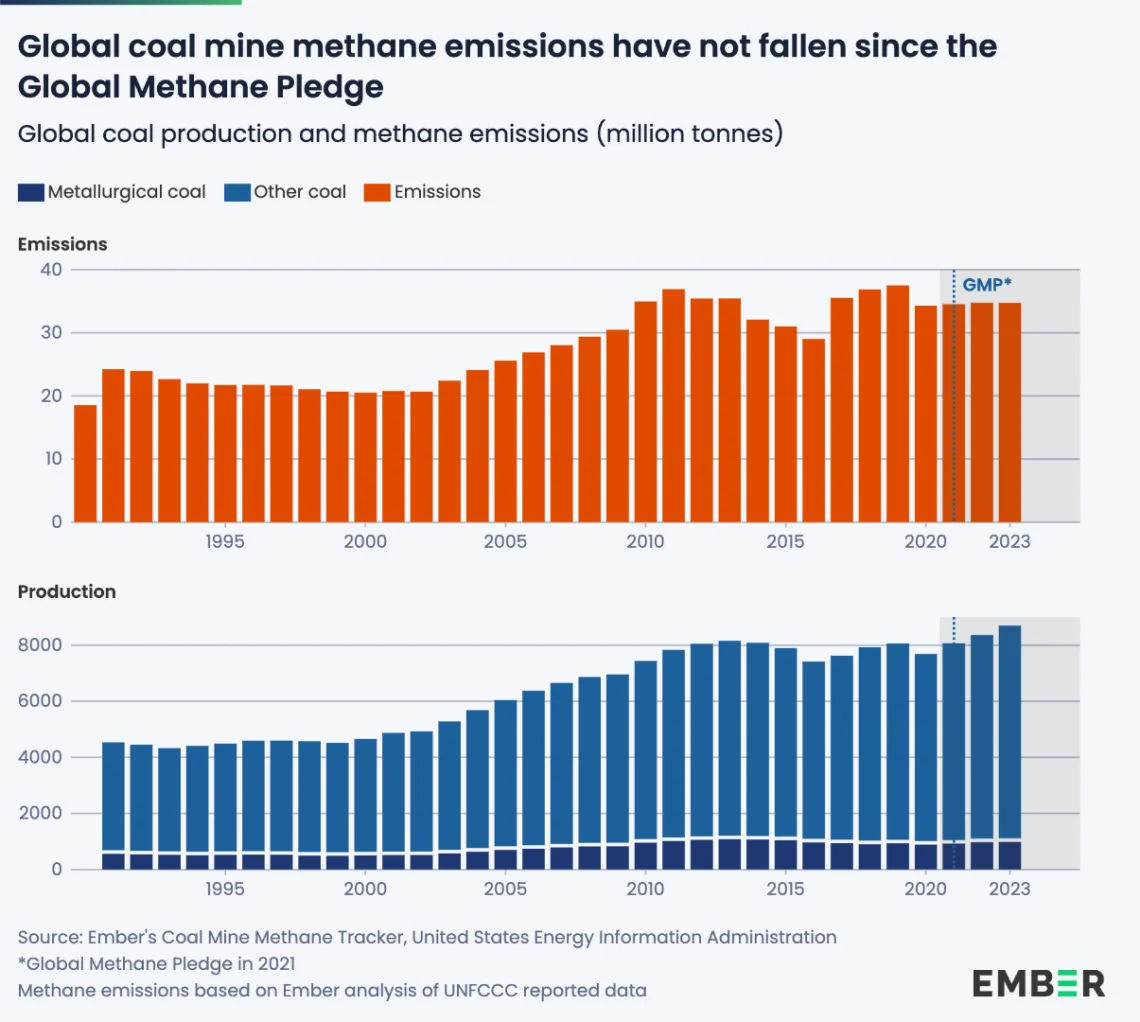
The analysis, based on the Global Coal Mine Methane Dataset, shows no decline in emissions since the launch of the Global Methane Pledge, which aims to reduce global methane emissions by 30% by 2030.
Five years after its launch, the initiative has yet to produce tangible results.
Methane is a highly potent greenhouse gas, with a much stronger short-term warming effect than carbon dioxide. It is released during and after coal extraction, yet remains poorly monitored and largely overlooked in policy implementation.
A limited number of countries account for most emissions. Around 94% of global coal mine methane emissions come from just seven countries: China, United States, Russia, India, Australia, Poland and Ukraine.
According to the Global Methane Tracker 2025 by the International Energy Agency, methane concentrations in the atmosphere are now more than two and a half times higher than pre-industrial levels and are increasing faster than any other major greenhouse gas.
Lack of reliable data hides the real scale
Ember estimates that coal mining generated nearly 35 million tonnes of methane emissions in 2023, a level comparable to emissions from the oil and gas sectors.
However, actual emissions could be significantly higher due to the lack of accurate measurements. Only 23 out of 73 coal-producing countries reported coal mine methane data in 2023.
At least 31 million tonnes of emissions were not reported to the United Nations Framework Convention on Climate Change. Ember estimates that 89% of global emissions are missing from official inventories.
Moreover, 99% of reported coal production comes from countries that rely on generic emission factors rather than direct mine-level measurements.
“Coal mine methane emissions are largely unreported, masking their true scale,” said Rebekah Horner, analyst at Ember. “Yet solutions already exist and are ready for large-scale deployment. This creates a clear opportunity to accelerate climate action using available tools.”
Existing technologies could halve emissions this decade
The report highlights that existing technologies could significantly reduce emissions. More than half of global coal mine methane emissions could be cut within this decade using available solutions, some of which come at no net cost.
Methane released through ventilation air, a major source in underground mining, can be reduced using proven technologies such as regenerative thermal oxidisers.
Captured methane from drainage systems can also be reused as fuel, creating an additional revenue stream.
Recent disruptions in fossil fuel flows through the Strait of Hormuz have exposed the vulnerability of global energy supply chains. In this context, coal mine methane represents an overlooked energy resource that is currently being wasted.
The methane that could be captured and used directly from coal mines amounts to nearly 15 billion cubic metres, roughly equivalent to one eighth of the 112 billion cubic metres of LNG that transited through the Strait of Hormuz in 2025.
In emerging energy systems, including parts of Sub-Saharan Africa, improving methane capture could support both climate mitigation and energy access strategies.
“Global methane reduction targets will not be achieved without directly addressing emissions from coal mines,” said Nishant Bhardwaj of Ember. “This is a clear and concrete part of the problem that has been overlooked for too long. Acting now would deliver immediate climate benefits at a pace few other measures can match.”


